The ScHARRMOOC Diaries part VI - Managing participant enrolment
Since we allowed participants to start registering on our ScHARR MOOCs on the 8th Feb 2013 we have had a steady stream of sign-ups (with occasional ‘surges’). At the time of writing this latest ScHARR MOOC Diary entry we currently have over 480 registered ‘MOOCsters’.But how exactly are we managing this process? How are we ensuring that this doesn't incur an unmanageable administrative load?
Well, let’s start by looking at the process we have in place for accepting registrations.
The sign-up process
The process we were going to use had to be nailed down before we made anything available - changing once students started signing up would have been a disaster. We had 3 options for the entry to our MOOCs:- completely open, no signup - like a public-facing website that has scheduled activities. This would have made analysing the users of the course further down the line problematic not to mention any moderating.
- self enrolment, semi-open - the course available to view but with everything but the homepage hidden. They can only see as much of the course as we want them to see at the moment, so we can still turn on some of the tools and make them available before the start and we have a natural place in the homepage to post or link to additional information.
- it could be self enrolled with the everything hidden - this is what most MOOCs I have seen so far have done, with just a separate webpage outlining the course. Keeping as much information as possible inside the course made most sense.
We went for option 2. The process is outlined in the slide below...
As it mentions students can ask questions before or upon signing up - we have an account (scharrmoocs@sheffield.ac.uk) set up for handling enquiries and set aside time to check incoming mails generated by the sign up process for questions about the courses. This initially was handled by Luke but once the volume increased (we’ve had over 100 in a day) some admin help from Jess and Jon (thanks!) was arranged. We have created a MOOC FAQs page, based on the kinds of enquiries we are receiving from would-be participants, to help minimise the admin load.
Who is signing up?
So, whilst coursesites enables us to process our participants in a fairly automated way, we do still have some manual admin tasks that require regular attention. For starters, we wanted to keep an up-to-date record of who was signing up to which MOOC and when. We are gathering this information by capturing registration request numbers in a google spreadsheet which is updated (manually) daily.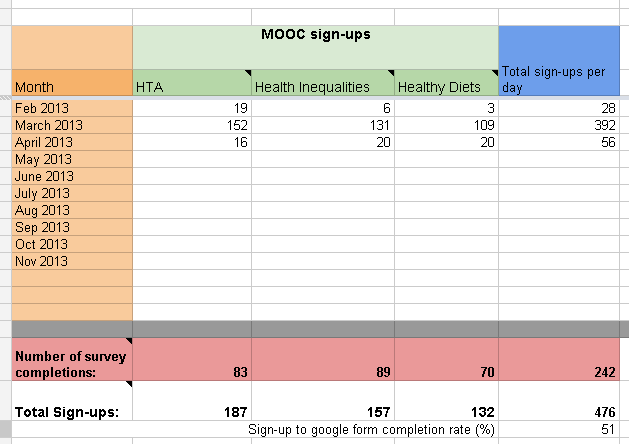
We also wanted to record some basic demographic information about who was actually signing up. More specifically, for each signup, we were interested in the following information:
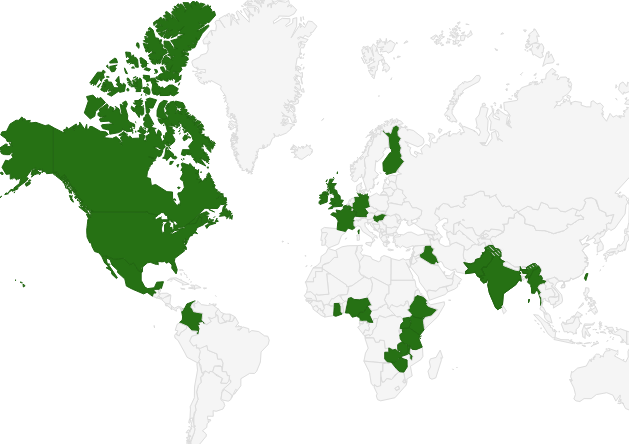
This information is gathered using a google form and for each MOOC we can start to get a picture of where (globally) our participants are coming from
- Age
- Gender
- Location
- How they heard about us
- Why they are doing it
This information is gathered using a google form and for each MOOC we can start to get a picture of where (globally) our participants are coming from
We were also keen to monitor the amount of resource which was being invested internally in terms of staff hours (broken into different roles such as ‘academic’, ‘admin’ and ‘learning technologists’). This would ultimately help inform our ScHARR MOOC evaluations and help with decisions about the viability of running future MOOCS.
Finally we’ve also embedded google analytics into several pages that lead into the MOOCs - more about those in another post once we have more information from them.
For more information or to sign up go to our ScHARR MOOCs registration page.
Luke and Dan