Friday, 24 May 2013

ScHARR MOOC Diaries - Part XI: The faces behind the ScHARR MOOCs


The Faces behind the ScHARR MOOCs


Prior to beginning work on the ScHARR MOOCS, we assembled a dynamic team of experts from within the School of Health and Related Research. We thought it was about time we revealed a little more information about the them, so here's an informal glimpse into the psyches of the key players.


Name: Nick Baxter
Role: Marketing Officer for ScHARR
Background: Journalism, social media, communications and marketing
What excites you about MOOCs: The idea of people from all over the world using technology to participate in the same experience in real time is really exciting. Another amazing demonstration of the power of the internet.
What are you hoping to get out of running a MOOC: A greater understanding of how this type of free online course can be marketed, and how our learners from all over the world consume information relating to them.


Name: Claire Beecroft
Role: Course tutor on the HTA MOOC and Deputy Course Director of the MSc in Health Technology Assessment, Pricing and Reimbursement.
Background: I started out in health libraries and that lead to becoming a ScHARR Information Specialist, and eventually into teaching. I teach on online learning courses in ScHARR and am interested in health economic decision making and the media representation of it.
What excites you about MOOCs: The chance to teach to a very wide audience, to widen awareness of health technology assessment and its methods, and to reach hundreds or even thousands of students!
What are you hoping to get out of running a MOOC: To learn about healthcare systems internationally from those that work in them and/or are users of them, and to 'meet' our students online via forums/twitter/hangouts.


Name: Chris Blackmore
Role: Distance Learning lead for ScHARR
Background: I am a researcher in mental health with a special interest in research around e-learning
What excites you about MOOCs: The potential diversity of participants, and the opportunity to engage with people who might otherwise never have the chance to study at the University of Sheffield
What are you hoping to get out of running a MOOC: A glimpse at where education may (or may not) be headed in the future


Name: Dr. Chris Carroll
Role: Senior Lecturer in Health Technology Assessment (HTA)
Background: Conducting HTA for NICE; methods research for HTA
What excites you about MOOCs: We all encounter health technologies (drugs, devices, diagnostic tests) in our lives. A MOOC offers almost anyone anywhere the chance to access some of our course materials for free, and begin to understand how and why health technology assessment is performed
What are you hoping to get out of running a MOOC: To give those with an interest in the topic of health technology assessment a good overview of the whole HTA process; to explain how we get from industry developing technologies to healthcare services and providers deciding whether or not to pay for them; awareness raising; a first step in the creation of an informed audience for health care decision-making


Name: Dr. Angie Clonan
Role: Research fellow in ScHARR; Course leader for Sustainable diets MOOC
Background: Public health nutrition research
What excites you about MOOCs: Engaging with a global audience made up of people from all walks of life....
What are you hoping to get out of running a MOOC: Participation, debate, shared learning and lots of fun along the way!


Name: Dr. Michelle Holdsworth
Role: Senior Lecturer in Public Health and Course Tutor for Sustainable diets MOOC. I am also ScHARR's Director of Learning and Teaching.
Background: I have over 25 years experience in public health nutrition, including developing nutrition policy, lecturing and researching public health nutrition. My research is mainly focussed around the global obesity pandemic, and I have been working on the nutrition transition in low and middle-income countries for a number of years.
What excites you about MOOCs: allowing students from all over the world to have a taste of ScHARR's courses
What are you hoping to get out of running a MOOC: I am looking forward to an enriching experience, learning from the different cultural perspectives of students enrolled on the course- and how this influences the debate on sustainable eating patterns.


Name: Luke Miller
Role: Learning Technologist
Background: Supporting the adoption of technology enhanced learning with a school and with the creation and delivery of a suite of new Distance Learning programmes. These MOOCs share similarities with the kind of work I've been involved in previous but have a slightly different flavour in that they are open and not formally assessed.
What excites you about MOOCs: The idea that you can sign up at the press of a button for free and begin learning with no barriers. The idea that online tutors can reach almost an unlimited number of willing students. The fact that MOOCs can potentially provide educational benefits to those who may otherwise for various reasons struggle to participate in something similar.
What are you hoping to get out of running a MOOC: One thing I'm really keen to do from a technical stance, is assess the platform we've chosen (coursesites.com). This is an open platform with which our institution's workforce is already familiar. It includes lots of rich tools to support collaboration and learning. I'm hoping that my suspicion that the chosen platform is well suited to providing a rewarding cMOOC experience is proved to be true. I'm also keen to engage with people from all over the globe and to hear about the stories and experiences shared on these new learning journeys.


Name: Dr Katie Powell
Role: University Teacher in Public Health
Background: Sociology Masters and Research into social initiatives to improve health.
What excites you about MOOCs: The opportunity to start a conversation about health inequalities with so many people from across the world
What are you hoping to get out of running a MOOC: Meeting some people with an interest in this topic and hopefully, some interesting ideas about understanding and addressing health inequalities. I'm really looking forward to trailing our online teaching activities in an open access forum


Name: Dan Smith
Role: Learning Technologist
Background: Long-term keyboard jockey and general compu-bod that's spent far too much time working with virtual learning environments.
What excites you about MOOCs: the possibilities... they're still not particularly defined at the moment, and the idea of having an open platform that thousands can get to freely seems like one that offers a lot of potential. The platforms we use for running most of our online courses at them moment are very locked down - with good reason, but this makes them very constraining for many things, such as cross-institution work, peer networking or post-graduation revisiting. Could we use an open course as a pre-registration induction resource for students? Maybe the jumpoint for a personal learning network? Hopefully running one will help give a realistic insight into what is possible.
What are you hoping to get out of running a MOOC: It's a new way of running an online course for me, and will be a brand new experience. I'm hoping to learn a lot! Maybe it will become a new regular part of the university experience, maybe we can discover new options and limitations available through using an online platform.


Name: Andy Tattersall
Role: Information Specialist
Background: A mixture of journalism and informatics which means I'm naturally nosey, inquisitive and like to test the water in whatever I do, teaching, research or supporting my colleagues. My role is primarily to watch the skies for new and exciting opportunities to engage with technology and get my colleagues to embrace the Web whilst keeping an eye on pedagogy.
What excites you about MOOCs: Several things, but in a nutshell their potentially altruistic value, technological experimentation, the feeling we are on a journey into the unknown and that this could be part of a brave new world in education. I think education should be fun (where possible) and engaging, MOOCs have that potential.
What are you hoping to get out of running a MOOC: This is one large learning curve for everyone involved and that in itself is value. I think it's always important to test yourself and evolve where possible, I'm lucky enough to be involved in this project with such a great bunch of like-minded people.


Friday, 17 May 2013

The ScHARR MOOCS Diaries: Part X - The cost of developing a MOOC

The cost of developing a MOOC


So by now, we have got the idea that MOOCs are (usually) free for students. But what about the costs of developing them? How much does it cost to create a MOOC? And what benefits (financial and otherwise) do they bring to ScHARR?

By Isabelle Grosjean ZA (Self-published work by ZA)
http://commons.wikimedia.org/wiki
/File%3AMontreGousset001.jpg

The most obvious cost to ScHARR is the amount of staff time that is being devoted to the MOOCs. But what counts as MOOC development time? Some things are obvious- time spent in planning meetings, time spent scripting, setting up and recording audio and video resources for the MOOCs. Other activities are more debatable- if I spend a bus journey to work looking for MOOC-related tweets, and retweeting interesting ones, should this be included in calculations? What about time spent by staff actually studying on other MOOCs? Time spent chatting about MOOCs with University colleagues here in Sheffield? Time spent writing “ScHARR MOOC Diary” blog postings...?


We asked staff members to decide what activities should and should not be included, accepting that the final figures may end up being approximations rather than accurate measurements of time. We then needed a simple process for recording these hours. Rather than recording time on separate activities, we invited staff to keep a note, on a weekly basis, of time spent on “any activity which contributes directly to the development of our 3 MOOCs”. In addition, we made the decision not to keep the 3 MOOCs separate, because so much of the development work has involved all 3 courses, or has been done as one larger group of staff. To make this an open and collaborative process, we set up a google form, with data shared amongst all the MOOC staff- hopefully no-one has felt threatened by sharing details of their input in this way. When it became apparent that it was difficult for all staff to keep the google form up to date, we decided that at our fortnightly MOOC meetings, an iPad would be passed around at the start so people could update their figures then if needed.

Interim figures are shown below- names have been anonymised, although you can see, bottom left, a highlighted table with the contributions thus far of different staff groups. Whilst we would currently treat these figures with some caution (and after this blog is published, I imagine there might be some retrospective updating of the numbers!), the data so far collected suggests that it is the two members of staff leading the forthcoming MOOCs (“Healthy sustainable diets” and “Health Inequalities”) who have put in the most work so far (around 30% each of total number of hours recorded).


Logging the hours


In due course, we will be able to put some figures against the recorded hours, based on staff salaries, and to arrive at an overall figure for developing and running our 3 MOOCs. How closely this corresponds with other estimates remains to be seen. The University of Edinburgh’s MOOCs, run in early 2013 via Coursera, cost an estimated £30,000 from development to delivery whilst  the University of Pennsylvania’s MOOC courses (also developed on behalf of Coursera) cost $50,000 each to develop.

There is plenty of ongoing discussion about the costs and benefits of running MOOCs, and much speculation about different models for monetization. At ScHARR, we will only be able to make an informed comment on these issues once the first courses are complete, and we’ve had a chance to estimate how many MOOC participants converted to postgraduate study at ScHARR, and what value the other benefits- such as the networking opportunities for ScHARR and the impact on our reputation- might have. Nevertheless, we are quietly confident that the investment we are now making will bear financial and educational dividends, for students, staff and ScHARR.

Sign up for the ScHARR MOOCs here.


Friday, 3 May 2013

ScHARR MOOC Diaries: Part IX: Pressing On - Using press packs to spread the MOOC message


A few months into developing and supporting the ScHARR MOOCs, it has become obvious that the task of promoting MOOCs is an onerous one. We had set out early to build a list of who we should be promoting our courses to on a local, national and international level. Even though we have years of experience and expertise in promoting our courses to our traditional and distance learners, MOOCs are very different in that the entrance level from that of a taught or research masters is lower. MOOCs act as tasters for a topic and a course or be ‘lite’ versions designed especially for those who just want to dip in and out of education and development. So the market for promoting them is, well, massive; anyone from school-age to a pensioner can take our MOOCs and that’s where the marketing focus shifts.


The ScHARR MOOC team have their own personal contact groups and resources they can promote the course, but unlike our established courses there is a need to get the message further afield and with that it means more work, repetition and refinement of where that message is channelled. This is where the press pack comes in handy as with promoting a MOOC there is the need for refinement and repetition which amongst all of the content building, support and meetings means that promoting the courses can be neglected. A press pack allows us to share the course in a quick and simple way by covering the basics of the courses in a way that it can be shared by others without any explicit knowledge.


The pack contains these items:


  • Word and PDF one page releases for each of the three courses - their objectives, learning, outcomes, about ScHARR and what a MOOC is, as the purpose of these courses is to reach as far beyond the academic firewalls as possible.
  • Colour posters promoting the three courses, one generic and another focused towards the NHS.
  • The ScHARR MOOC Business Card
  • QR Codes for each course - as with the press releases allowing others to sharealike and help promote the courses within their own organisation.
  • A one page ‘copy and paste’ document for adding into message bodies of emails and other communications, with the intention of saving time in writing a welcome for each mailout.


The automation process is not devoid of a human aspect as the majority of communications via Social Media, discussion forums and emails will still remain bespoke communications. Nevertheless it became obvious for our team early on that promoting the MOOCs to larger, sometimes unfamiliar communities required something more than piecemeal communications that had the potential to lack in uniformity and cohesion. The press packs are not exclusively directed at the students, but also those who champion learning in organisations, communication officers, librarians and teachers to name but a few.

By putting in the work now we potentially save time further down the line and have a consistent flow that matches content on our website and the CourseSites platform.

The press packs can be accessed and downloaded here:

Friday, 19 April 2013

ScHARR MOOC Diaries - Part VIII: Developing a template for structuring weekly MOOC content

'Where MOOCs and online dating sites collide' by Luke Miller
Last week, members of the ScHARR MOOCs team met to decide on how we could best deliver the content for each of our MOOCs. If you have been fortunate enough to participate in a MOOC already, then the chances are you will be aware of the many differing modes of delivery available (see Jenny’s post for more information on xMOOCs vs cMOOCs).

Traditional formats appear commonplace in the current MOOC offering, for example, having delivered content, the course leader will sit behind a desk and discuss some of the concepts and debates raised by MOOC participants that week. Indeed there are approaches which are even more ‘hands-off ‘ than this!


The MOOC mob all agreed that we wanted to be innovative and offer something that would differ from this traditional approach. We wanted to foster a greater degree of interactivity and engagement. The challenge here of course is that like everyone else we don’t have an unlimited resource of tutor time to plough into it.


Recent discourses in online learning have offered a replacement to the concept of the ‘sage on the stage’, and the notion of a ‘guide on the side’ has emerged as one alternative for the role of the tutor in online distance learning.  Again, this notion didn’t quite capture our vision for the dynamic we were hoping to foster with our MOOC participants. We spent some time playing with words which encapsulated our fresh approach to MOOC hosting, and we have arrived at the following mission statement: 'the architects who project, collect, dissect and connect’


To expand on this:


  • project (broadcasting / presenting content to stimulate the discussion),
  • collect (collating resources, responses and discourse)
  • dissect (unpick the discourse and identify the key issues of importance to the subject and our participants)
  • connect (we are all about connections - building and fostering links with and between participants and areas of interest to further the subject understanding)


The notion of subject expertise is, for many, becoming less widely held. Certainly, having completed four years of research into a particular field, culminating in a thesis , one is likely to have a greater understanding and knowledge of their specific subject than the average person. However in this age of ‘information overload’ it never fails to amaze me just how informed and engaged the ‘average’ person is on food issues – even if sometimes the information obtained is not so accurate. Combine this with the global context of student populations (we have participants enrolling on our MOOC from all corners of the globe), and the often specific cultural focus of academic research and it soon becomes apparent that as course leaders there is the opportunity for vital information exchange. For a subject area like healthy and sustainable diets, this provides a learning experience  for us as course tutors, but also between our MOOC participants, and could enable new links to be forged, providing a platform to connect interested parties for future research projects.Therefore arguably the research field is developed as our global understanding of how scenarios impact on different communities in different ways is built upon through participant discourse.


So back to our meeting. The big question of how we were going to deliver our content loomed and we talked about the different options, the tools at our disposal and the pedagogical benefits or different avenues. We settled upon a template which we could apply to each MOOC’s weekly content. Having such a template would hopefully mean the students would quickly become orientated with the structure and how to study each week. It also meant that staff working on developing the MOOCs had a ready made mould into which they could poor materials and so on. Being the first MOOC offered by the university, we wanted to keep the outline format as simple as possible, and not commit ourselves to anything we wouldn’t be confident in delivering, or which may overburden our participants. We finally settled on a weekly template, shown below:


Our Weekly template:


We will be presenting weekly content in the following format.


1. First of all the week’s intended learning outcomes will be shared with the participants just to formalise what we’re hoping the achieve during the week.


2. We will then provide a short video (approximately 2 minutes) which will take the form of a talking head from one or more of the MOOC leaders. The video will introduce the key course content for each week, and highlight any other significant tasks or exercises so the participants will know exactly the scope of their week’s learning and what is being expected from them.


3. We will then provide a series of pages of content which will be varied and may include one or more of following:


  • Pages of guided reading (either onscreen or by pointing to openly available articles and reports online)
  • Screencasts or videos (pointing to resources such as youtube, vimeo, echo360 and screencast-o-matic)
  • Weblinks to interesting and relevant website or policy documents etc.
  • Opinions from multiple academic staff or subject experts
  • Self-assessment questionnaires to check as participants progress through the week that they are understanding.
  • Formative “reveal box” activities whereby participants are asked a question and invited to type an answer before being provided with a ‘model’ answer with which they can compare to their own response.
  • Images, diagrams and tables of information


4. We will provide weekly topic areas giving participants the opportunity to post reflective blog entries. These will be shared with the cohort. Participants will be encouraged to engage in the ‘community spirit’ by reading and responding to each other’s reflections.


5. A synchronous “live” Blackboard Collaborate session will be scheduled at the end of each week in which the MOOC tutors will present consolidatory slides on the week’s learning, discuss the blog topic area and pull out interesting posts and comments. These sessions will participatory (we will use the chat window for comments during the session) and will also seek to answer any questions that the MOOC team have received during the week and also give a preview of what will be covered in the following week.


6. In addition to the Collaborate session, we will be opening a weekly discussion forum where conversations can be continued outside of the live session. Due to the potential volume of posts in these forums, we will be offering a ‘loose’ moderation style, ie the MOOC team will monitor posts for appropriateness however will not guarantee that tutors will respond to threads.


Alongside all of the above, we will be encouraging participants to engage with the MOOC tutors in tweeting using the hashtags we are associating with the MOOCs. For the diets MOOC we will be using #dietsmooc. The MOOC welcome pages will contain an embedded twitter feed filtering in all tweets which use this hashtag. Participants are welcome to start tweeting amongst themselves prior to the course commencing, and indeed to respond to Tweets posted by course leaders.


All in all this is an exciting prospect for us as course leaders, but also for all our participants who have enrolled on one of the ScHARR MOOCS. The prospect of being part of such an exciting project which combines learning, participation and research all in one is waiting to be embraced, and we encourage everybody to get on board!


Angie and Luke


Friday, 12 April 2013

The ScHARR MOOC Diaries part VII - Jack and the Giant Course - Getting a MOOC to Market


Jack and the Giant Course - Getting a MOOC to Market

'The Only Way is Up' - © Luke Miller - Image used under a Creative Commons By Attribution  Licence 


When creating a MOOC there are several factors you have to consider, all of which eats up precious time. From the previous posts on whether we can actually do this to deciding on a platform, and pulling a team of experts together, we can see that setting up and running a MOOC is no easy thing - and we’ve not even got on to the other 'M' word just yet - marketing.


Marketing in the traditional sense is quite simple, you identify a target group who you think might be interested in your product and push it that way. MOOCs are quite different from that, first of all we are running three health-related courses, which naturally is of interest to a wide range of people and organisations, from the NHS to BUPA, from governing bodies to charities, from health practitioners to members of the general public, and ultimately this can be applied on a global scale.

So the courses are truly global in their appeal as we are all interested in our health and that of others in some way. This potentially means there are a lot of interested parties and individuals that we want to get the message to and as I said earlier, running a MOOC is labour intensive regardless of marketing. 


By Colin (Own work) [CC-BY-SA-3.0 (http://creativecommons.org/licenses/by-sa/3.0)], via Wikimedia Commons


So with that in mind we are treating the marketing of our MOOCs like an onion, that there are many layers we need to peel back.

Firstly starting closest to home we already have a cohort of current health-research students on site, most of whom are from Africa and Asia. As we saw in Dan Smith’s post on managing participant enrolment we have managed to entice students from that part of the globe to our MOOCs. Certainly the anecdotal evidence from a lot of MOOCs is that the majority are being undertaken by people who either have a higher education background, whether as students or staff. Certainly every MOOC seems to attract students who are academic staff who are either interested in the course content or more often how the MOOC is run. The real untapped potential of MOOCs is that they begin to attract the greater numbers of students who have not attended a higher education establishment before in addition to those from parts of the world where this is much harder to attain specialist health education..

We also want our staff to enrol on the courses, whether just for the in-house pilot we plan to run ahead of the first course or as students when they are formally released. The main reasons being that they get to not only see and feel what it’s like to be in a MOOC, but to be a distance learner as some may go on to deliver learning via our various e-learning channels.

The next layers are the Faculty of Medicine of which we are part of, with over 1000 staff and several 1000 students we want them to take part in the first MOOC at the University of Sheffield. Much of this marketing will and has taken place via internal electronic mailing lists, personal contacts, our ScHARR MOOC Diary Blog and the University Learning Technology Blog. Then there is the whole University, again the courses will be publicised as previously mentioned but will also include features on our University homepage, thus taking us beyond the University firewall, which has huge potential. On campus we can employ traditional marketing methods including posters, newsletters and business cards. Whilst any colleagues travelling to conferences and events have been encouraged to take our MOOC materials with them.


It’s beyond this firewall where much of our marketing will take place and for this to happen more effectively we need champions and support beyond our MOOC team. This comes from internal experts who work in our marketing and media teams to help channel the news of our MOOCs to established contacts with national and international organisations. We are based in Sheffield, at a University that has strong ties with the local community, a community that has inequalities in the quality of health of its population.

So it’s fitting that our courses, one of which is on the said topic reaches out to those with an interest in it. We plan to promote the courses to local organisations, the two large teaching hospitals, charities and individuals who will benefit from this open sharing of health education. We have good connections with the local media, from BBC Radio Sheffield to the Sheffield newspapers, who really can reach out to the local population. 

It’s at this point that a need for translation becomes much more important, for those of us who have worked at an academic institution and gotten our heads around MOOCs it is all too simple to forget that to others things can get lost in translation - how many people outside of a university knows what a MOOC is? 

As someone who spent a lot of time reporting on council and court proceedings as a journalism student some many years ago I learned how important it was to turn council-speak and legalese into something that the person on the street could understand. Talking about MOOCs is OK, but sometimes we have to understand that not everyone knows what it is, and why it may be different from another online course that is free. By writing a simple one page ‘press release’ or offering FAQs and glossary of terms we remove much of the barriers that sometimes intimidates those who have never set foot on an academic campus.

The courses are of massive potential for the NHS, an organisation where staff often struggle to find time or funds for carrying on professional development. Reaching out to the NHS is not always that easy due to the scale of the organisation and barriers set around it, so champions are needed. As for champions they rarely come more enthusiastic or connected than health librarians with a huge network of NHS libraries to collaborate with. Libraries are often the central hub of health organisations, so are an ideal place to help spread the courses organically. The altruistic nature of MOOCs has been a driving force for us at ScHARR and by including the NHS as best as we can it feels we are giving something back to this important workforce. As the marketing starts to extend nationally and globally it becomes increasingly important that the duplication of effort is paid attention to. Anyone involved in running a MOOC can transmit the courses via their personal networks, and over time the need for a single uninformed message explaining in simple terms what the courses and MOOCs in general are about. The plan to explore is by collaborating with journalists, academics and established bloggers based in the health education sector by sending press packs. These packs will include short briefs on each course, something about MOOCs, and ScHARR, poster materials and business cards.

Video is also an important part of our marketing strategy and we have already recorded our first one wit Dr Angie Clonan introducing our MOOCs.


According to technology giant Cisco Systems, video is forecast to be the dominant format for mobile and computers and with YouTube uploading 72 hours of content for every hour we have understood at ScHARR for some time that video is increasingly an effective way to communicate, teach and learn.

Discussion and mailing lists may have been around for decades but still remain an important communication tool for discussing everything from health to communication. The opportunities for marketing the courses is extensive. These will include JISC mail lists, Environment Job, Charity Job email lists to name but a few.

In addition, video channels (such as YouTube and Vimeo) and other social media channels are being explored. This obviously means targeting Facebook and their groups, LinkedIn, ResearchGate, Academia.Edu, Mendeley Groups, alongside other the micro-blogging giant Twitter. Already we have seen spikes in our enrolment numbers potentially attributed to the little bird and tweets we’d posted about our MOOCs. We have already employed the #scharrmoocs hashtag via our @ScHARRsheffield and @openScHARR accounts and posted on our ScHARR Facebook pages. At the University we have been using Google Apps for Education for nearly two years now and many of the #scharrmoocs team are active on Google+ as a result sharing updates on the courses there.

The ScHARR MOOCs for this summer/autumn are all hosted on the Blackboard platform Coursesites as discussed in our second post. This brings our courses to the huge number of students already undertaking courses there. Our courses are part of the catalogue of courses hosted by other institutions that will hopefully bring additional students to our course, with the benefit of many already using the Coursesites platform previously to undertake a MOOC.

There are countless avenues for anyone starting up a MOOC and we’ve only covered a few here. It very much depends on your target audience, but the MOO in MOOC is a clue as to how you promote your course. They are potentially massive, and certainly on-line and open, so the sky is literally the limit as to how far you pitch them. The only real limit is a big one and that is resources, getting the message out there effectively is no small thing. Following up posts and mail outs and checking for responses in threads and groups could potentially take up more resources. To go back to the analogy of the title, when you do start planting the seeds you are unsure of what will grow and how big it will get. With an effective marketing plan you not only have a better chance of making your MOOC massive but you also build the networks for future courses and for established communication channels with your students that begin before and hopefully do not end ‘ever-after’ the course has finished.

Monday, 8 April 2013

The ScHARRMOOC Diaries part VI - Managing participant enrolment


The ScHARRMOOC Diaries part VI - Managing participant enrolment

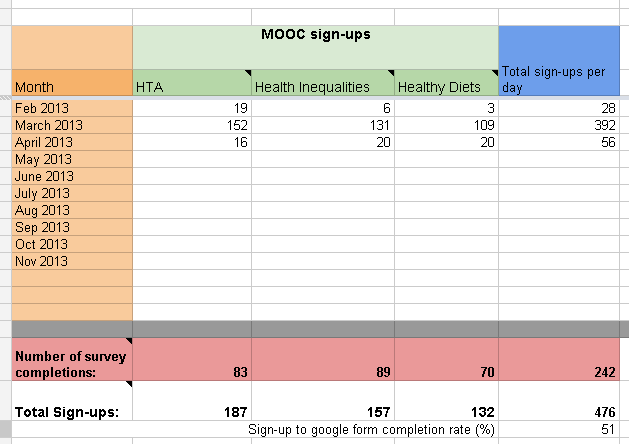
Since we allowed participants to start registering on our ScHARR MOOCs on the 8th Feb 2013 we have had a steady stream of sign-ups (with occasional ‘surges’). At the time of writing this latest ScHARR MOOC Diary entry we currently have over 480 registered ‘MOOCsters’.

But how exactly are we managing this process? How are we ensuring that this doesn't incur an unmanageable administrative load?

Well, let’s start by looking at the process we have in place for accepting registrations.

The sign-up process 

The process we were going to use had to be nailed down before we made anything available - changing once students started signing up would have been a disaster. We had 3 options for the entry to our MOOCs:
  1. completely open, no signup - like a public-facing website that has scheduled activities. This would have made analysing the users of the course further down the line problematic not to mention any moderating.
  2. self enrolment, semi-open - the course available to view but with everything but the homepage hidden. They can only see as much of the course as we want them to see at the moment, so we can still turn on some of the tools and make them available before the start and we have a natural place in the homepage to post or link to additional information.
  3. it could be self enrolled with the everything hidden - this is what most MOOCs I have seen so far have done, with just a separate webpage outlining the course. Keeping as much information as possible inside the course made most sense.

We went for option 2. The process is outlined in the slide below...


As it mentions students can ask questions before or upon signing up - we have an account (scharrmoocs@sheffield.ac.uk) set up for handling enquiries and set aside time to check incoming mails generated by the sign up process for questions about the courses. This initially was handled by Luke but once the volume increased (we’ve had over 100 in a day) some admin help from Jess and Jon (thanks!) was arranged. We have created a MOOC FAQs page, based on the kinds of enquiries we are receiving from would-be participants, to help minimise the admin load.

Who is signing up?

So, whilst coursesites enables us to process our participants in a fairly automated way, we do still have some manual admin tasks that require regular attention.  For starters, we wanted to keep an up-to-date record of who was signing up to which MOOC and when. We are gathering this information by capturing registration request numbers in a google spreadsheet which is updated (manually) daily.


We also wanted to record some basic demographic information about who was actually signing up. More specifically, for each signup, we were interested in the following information:
  • Age
  • Gender
  • Location
  • How they heard about us
  • Why they are doing it

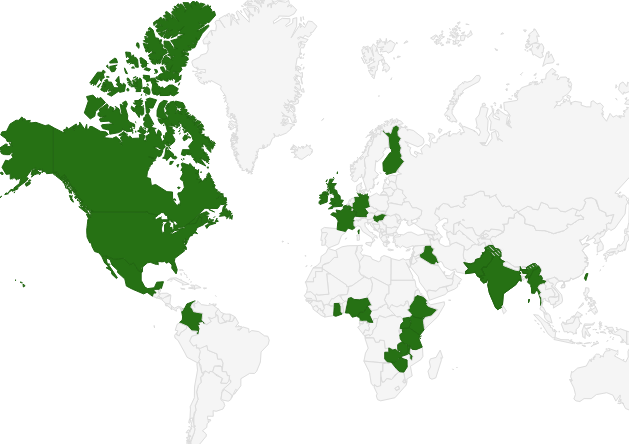
This information is gathered using a google form and for each MOOC we can start to get a picture of where (globally) our participants are coming from


We were also keen to monitor the amount of resource which was being invested internally in terms of staff hours (broken into different roles such as ‘academic’, ‘admin’ and ‘learning technologists’). This would ultimately help inform our ScHARR MOOC evaluations and help with decisions about the viability of running future MOOCS. 


Finally we’ve also embedded google analytics into several pages that lead into the MOOCs - more about those in another post once we have more information from them.

For more information or to sign up go to our ScHARR MOOCs registration page.

Luke and Dan

Friday, 22 March 2013

The ScHARR MOOC Diaries: Part V - The birth of the Sustainable Healthy Diets MOOC


The birth of the Sustainable Healthy Diets MOOC 


Picture the scene: ScHARR common room, on a cold and wet autumnal day in 2012, Michelle
Holdsworth and myself deep in dual brainstorming mode; our conundrum was unique: how could
we reach a wider audience with the essential information on diets which were both healthy and
sustainable? Colleagues at Universities and NGO’s all over the UK and Europe were conducting
exciting research, highlighting new findings every week, but these were mainly being published in
scientific journals, never to be read by ordinary folk. It would take ages, literally years for this info to
be written into policy (if anyone at No. 10 was ever interested!) and even longer for the public to be
able to make changes to their eating habits…….

By KMJ [GFDL or CC-BY-SA-3.0
(http://creativecommons.org/licenses/by-sa/3.0/)],
via Wikimedia Commons
Then, a light bulb moment – “I know” said Michelle, rather excitedly, “we should do a MOOC on a
healthy and sustainable diet!

Excuse me?” I answered, a little confused to say the least, thinking I must have misheard or maybe
Michelle was referring to some scientific term that I had not yet come across.

Yes a MOOC – these new types of courses, stands for ‘Massively Open Online Course’. They have
been done by a few of the American Universities.” Michelle explained a bit more to me and it soon
became apparent that we would at least have to give this a try: it was too good an opportunity to
miss out on.

A few months later and we are about to convene our first MOOC group meeting. Although I am
really excited about getting started, I am also very nervous on a number of fronts!

Firstly, the technological learning curve is going to be very steep for me: reassuringly I am
surrounded by experts, so I’m hoping this should ease the climb!

Secondly, I am concerned about including ABSOLUTELY EVERYTHING that needs to be said on
healthy and sustainable diets, as I know the academics and NGO professionals working in this field
are passionate and will not be all that forgiving of any errors or omissions! Therefore I am going to
try to showcase as much of this fantastic work as I can fit, within learning objectives, to ensure that
this doesn’t happen. This should make for some lively debate! Although we will be covering some of
the basics, which may be ‘old hat’ to some, it should be possible to include cutting edge projects and
research too.

Finally, I am hoping to have real engagement from my fellow MOOCsters: that’s any and all who sign
up to take part in the course. Previous MOOC’s have shown a number of ‘lurkers’, and I would like
this MOOC to be engaging and stimulating in order to generate some meaningful output that can be
used for the future, in particular thinking about how we can communicate this information to even
wider audiences!

Please be encouraged to sign up and take part, I promise it will be fun! If you wish to contribute to
any of the content or tell us about what is healthy and sustainable for you, then I would love to hear
from you. Angie.clonan@sheffield.ac.uk

(Posted on behalf of Angie Clonan)